The Hardest Part Isn’t Changing the Incentive. It’s Changing the Culture.
Post 8 of 10: The Potential Structural Transformation of the U.S. Electric Utility Industry

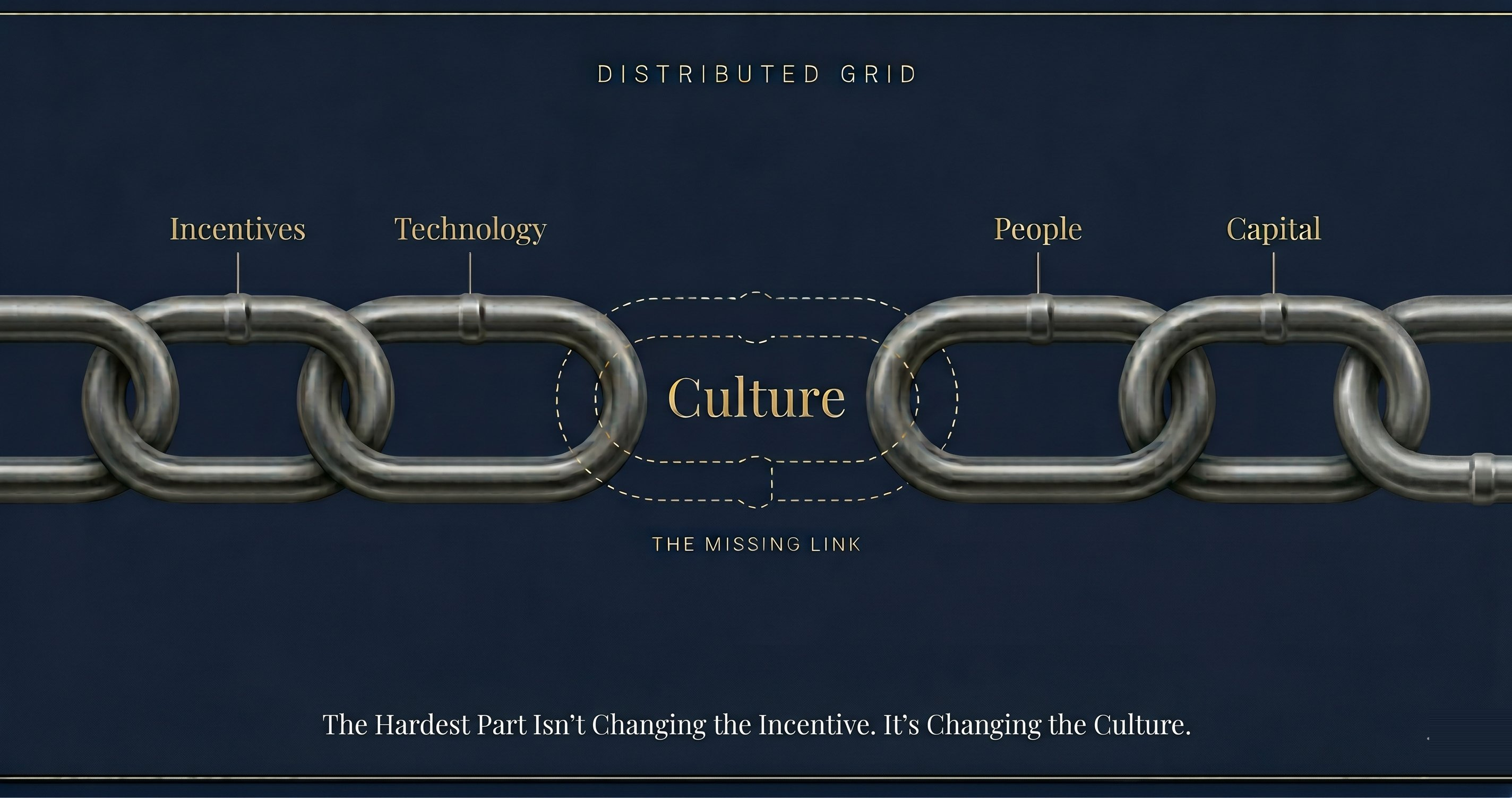
Culture sounds like a soft topic. In an industry where engineering and finance dominate the skillset, it can seem like an unnatural thing to focus on. Culture for this post is not about team events or retreats. Instead, it’s about how decisions are made (or delayed) and how people are empowered (or not). That is exactly why culture is under-examined and a larger blocker to transformation than most recognize.
The last post described what the modern utility looks like. The constraint marketplace, the portfolio procurement model, the performance margin on cost deflation, the operating system that coordinates resources the utility does not own to deliver outcomes the utility is accountable for.
Building the modern utility is not a strategy problem. Any thoughtful utility executive who reads that post can see the business model. The problem is organizational. The people, processes, promotion structures, and operating culture inside today’s utilities were built over decades to optimize for the current objective: build more capex. Handing that organization a new compensation model does not make it a new organization. The gap between “we are now paid differently” and “we now operate differently” is where regulatory reform will go to die.
The Consequence Structure Kills Innovation Before Culture Does
There is an accountability asymmetry inside utilities that explains more about their behavior than any other single factor.
A modern distribution engineer proposes deferring a substation upgrade with a contracted battery fleet. The project gets a green light but the fleet underperforms during a summer peak, delivering 7 MW instead of 8 MW. The operator switches load to an adjacent feeder. No customers lose power. The contingency plan worked exactly as designed. The engineer still owns the incident report. It shows up in the next operations review, gets noted in the engineer’s performance file, and stays there.
A different engineer approves the $12 million substation upgrade. Load growth comes in 30% below forecast. The substation runs at 65% capacity for a decade, and the excess cost sits in rate base and gets recovered from ratepayers for forty years. No incident report. No operations review. Nobody’s career is affected. The cost is invisible to everyone inside the building.
Both operators are responsible for reliability and deliver it. But one decision carries personal, immediate consequences even when the grid outcome was fine. The other carries none even when the financial outcome was wasteful to customers. Every day, across thousands of decisions, the organization learns the same lesson: the conventional choice is safe and the unconventional choice is dangerous. That lesson has nothing to do with which choice is better for the grid or cheaper for ratepayers.
This looks like a culture problem. It runs deeper than that. It is a consequence structure that produces a culture. You cannot fix it with a training program, an innovation lab, or a slide deck about embracing change. You fix it by changing what happens to people when experiments fail and what happens when conventional decisions turn out to be wasteful. Until both sides of the ledger carry consequences, the rational choice will always be to build.
Procurement Cannot Execute What It Was Never Staffed to Do
The last post described what modern procurement looks like: option contracts, spot purchases, portfolio management across firm commitments and flexible capacity, performance penalties with teeth. That is a fundamentally different commercial function from what utility procurement does today.
Most utility procurement teams are staffed to execute a small number of large purchases on long timelines with vendors they have known for years. The approval workflows for large capital purchases assume months of review. The contracts are structured around physical delivery of equipment, not performance commitments from third-party operators. The team’s expertise is in negotiating unit costs on transformers and conductors, not structuring option contracts with exercise-or-release provisions.
Telling that team to run a portfolio strategy without changing the headcount, the skill mix, the approval chain, or the vendor relationships is a setup for failure. The team will default to what it knows, the new approach will underperform, and the organization will conclude that portfolio procurement does not work. What actually happened is that portfolio procurement was never resourced to work.
Changing it requires hiring commercial negotiators, contract structurers, and supplier relationship managers at a scale utility HR departments are not accustomed to recruiting. It also requires paying market rates for those roles, which creates internal equity problems with tenured employees in adjacent functions. Most utilities will avoid that friction, and that avoidance is a choice to preserve the old model.
Planning Produces What the Process Rewards
The last post laid out the planning shift: from deterministic load forecasts and single-option capital plans to probabilistic analysis, staged investment paths, and competitive evaluation of wires and non-wires options on a common basis.
A planning engineer who produces a single load forecast and sizes a capital project to the upper bound of that forecast is performing well by every metric the organization tracks today. The work product is clean, the regulatory filing is straightforward, and the project gets approved. Shareholders love the large project.
A planning engineer who produces three scenarios with probability weights and recommends a staged investment path that defers $8 million in capital pending 18 months of load data has created a more rigorous analysis. That engineer has also created a filing that does not fit the template, a capital plan the finance team cannot model in the usual way, and a recommendation that requires the utility to revisit the decision in 18 months rather than close the book on it now. The second engineer did better work but the first engineer is doing what is expected in the status quo.
Some utilities have begun to move. For example, Ameren Illinois now includes multiple scenarios in its distribution grid plan filing, and several California and Minnesota IOUs produce scenario analyses as part of their regulatory requirements. This is meaningful progress from the single deterministic forecast. But scenario analysis and probabilistic planning are different things. Scenario analysis says “here are three possible futures, we will plan to the one we think is most likely.” Probabilistic planning assigns probability weights across a range of outcomes and designs staged investment paths that adapt as uncertainty resolves. Most of the scenario work happening today is regulator-driven, which is telling. The utilities are producing scenarios because the commission ordered them to, not because their internal planning processes evolved toward it. This is a good start, but scenario analysis on its own does not address the deeper structural gaps: open information sharing between planning and operations, dynamic investment decisions that adapt as conditions change, and capital plans that compete wires and non-wires alternatives on a common basis in real time. That reinforces the point: planning produces what the process rewards.
Rate case filings expect a single plan. Commissions review capital against a single forecast. The entire procedural machinery is built to process deterministic inputs. An engineer who feeds probabilistic outputs into that machinery creates friction for everyone downstream, and the organization will select against that engineer over time. Not through any explicit decision, but through a thousand small signals about what kind of work gets praised, what kind gets ignored, and what kind creates problems. As earlier posts in this series argued, the rate case model itself is antiquated. A process where utilities bring a heap of data and get approvals for potentially multiple years of investments does not reflect a dynamic and changing power system. The planning engineer is responding rationally to a filing structure that has not kept pace with the grid it governs.
Planning and Operations Don’t Talk to Each Other
Planning operates on a multi-year capital horizon. Operations operates in real time. They report through different chains, work on different timescales, measure success differently, and in some utilities sit in different buildings. The amount of teams where they said they never or rarely talk to the other function is mind numbing. The data to close this loop exists in most utilities. SCADA systems track substation loading continuously. The structured process to feed that data back into planning decisions, where operations tells planning “the substation you sized for 50 MW has never exceeded 35” or “the load pattern on this feeder shifted two years after your forecast,” mostly does not.
That means planning rarely closes the loop at the asset level. System forecasts get adjusted over time, but the individual capital decisions those forecasts justified are almost never revisited against actual outcomes. The substation that was oversized, the feeder reinforcement that was never needed at its rated capacity, these generate no structured signal back to the planning team.
The information flows in one direction. Planning produces a capital plan. The plan moves through procurement and construction. Operations inherits the finished asset and runs it. What operations learns about how that asset actually performs, whether the load materialized, whether the capacity was needed, whether the investment matched the reality, rarely travels back upstream in any disciplined way. Individual engineers may have informal relationships across the two teams but the organization has no process for closing the loop.
To make matters worse, most organizations have siloed career paths. Rarely have I found people in planning who have actually spent material time in operations. It is more important for the people planning the system to be grounded in the real intricacies of operations, and I have found this to be rare. Which often leads to buying things that vendors sell, not what the operations team can use. COSR enables this because there is no penalty for buying the wrong thing so long as it gets approved in the rate base.
The modern utility changes this. The operator described in the last post makes staged investment decisions based on real-time grid conditions. That requires operations data flowing back into planning continuously, not once a year during a rate case preparation. A planning team that has no structured visibility into how its prior forecasts performed against reality will not produce better forecasts next time. A planning team that receives monthly utilization data on every asset it has sized in the last five years will.
The fix is not complicated in concept. Utilization reporting, forecast-versus-actual reconciliation, structured reviews where planning and operations sit in the same room and compare what was expected to what happened. Oil and gas companies reconcile well production against the forecasts that justified drilling. Real estate developers track occupancy against the projections that justified construction. These are standard practices in industries that make capital allocation decisions under uncertainty. They are not standard practice in most utilities because the cost-of-service model never required them. If the asset was used and useful, it earned a return. Whether it was sized correctly was a question nobody had a financial reason to ask.
The Talent Problem Is Real but Misdiagnosed
Engineers who understand both grid operations and software, regulatory strategists who design performance contracts, operations leaders comfortable with controlled experimentation. These people exist, they can be recruited, and most utilities have started trying.
The usual explanation for why it is not working is that utilities cannot compete on compensation with tech companies and competitive energy firms. That is partly true and mostly a distraction.
The deeper problem is what happens after the hire. A data scientist joins and discovers the decision process has no step where analytics gets consulted. An engineer with DER experience proposes a non-wires alternative and gets told the capital project is already in the plan. A project manager from outside the industry suggests structured prioritization against outcomes and learns that the rate case timeline is the only timeline that matters. Each of these people was hired to bring a different perspective. Each discovers that the organization’s processes have no place to receive it.
The utility posts the job again six months later. HR concludes that retention in technical roles is an industry-wide problem. The real problem is that the organization rejected the capability it just paid to acquire, and rejected it for reasons that were entirely rational within the existing system. The hiring manager, who has spent fifteen years producing work that gets approved without friction, is not going to champion a process change that creates regulatory risk for the department. Everyone in the chain is behaving logically. The system produces the outcome and some of the most creative people go on to competitive industries.
The Promotion Pipeline Selects for the Wrong Thing
The talent problem goes deeper than retention of new hires. It runs through the entire advancement structure.
Most utilities promote based heavily on tenure. Time in role, time at the company, familiarity with internal processes and institutional relationships. In a cost-of-service environment, this makes sense. The most valuable institutional knowledge is procedural: how rate cases work, how the commission staff thinks, which vendors deliver on time, how to navigate the internal approval chain. That knowledge accumulates with years. Promoting for tenure is promoting for the capability the business model rewards.
But tenure and merit are not the same thing. A high-performance organization measures output: did this person deliver results, solve problems, improve the operation. A tenure organization measures survival: did this person stay long enough, avoid major mistakes, maintain the right relationships. Both produce leaders. They produce different kinds of leaders.
The high-potential employee who joins a utility and performs well faces a specific calculation. The path to advancement runs through years of demonstrating fluency in the current model. The people above were selected by that same process, and the performance that gets recognized is the performance that fits the existing operation. An employee who pushes for a different approach to planning, procurement, or grid operations is not building the track record the promotion process values. That employee is creating friction.
Some adapt and learn to operate within the system. Some leave, and the ones who leave tend to be the ones the organization most needed to keep, because they are the ones with outside options.
Over time, the promotion pipeline produces a leadership bench that is deeply fluent in cost-of-service operations and has limited experience with anything else. That is the pipeline working exactly as designed. The design was optimized for a business model the industry needs to leave behind.
This connects directly to the consequence asymmetry from earlier in the post. Tenure-based advancement is another expression of the same structure: the system rewards avoiding downside, and the safest way to avoid downside is to stay long enough that your judgment is trusted by default rather than tested against results. The promotion criteria and the decision-making incentives reinforce each other. Together they produce an organization that is extraordinarily stable and extraordinarily resistant to change.
There are utilities where younger leaders have risen based on performance, and those individuals deserve credit for what they have accomplished. They also tend to stand out precisely because they are uncommon. The default pattern across the industry still favors time served over results delivered.
Organizational Permission Has to Be Built, Not Announced
A CEO who announces an innovation initiative at an all-hands meeting and then leaves the reporting lines, performance metrics, and approval chains unchanged has created a press release, not a capability.
What works is embedding new capability inside the operating units with different rules. A planning team with explicit permission to produce probabilistic analyses alongside the deterministic filing. A procurement group authorized to run option-based contracts on a defined subset of capital needs. An operations team with a performance framework that rewards managed experimentation. These are not separate organizations. They are different rules applied to specific functions within the existing one.
The innovation lab model that many utilities have tried gets this wrong. It isolates the new work from the core business and then struggles to reintegrate the results. The lab produces a proof of concept, the proof of concept gets handed to operations, and operations rejects it because it does not fit existing workflows. The lab concludes the organization is resistant to change. The organization concludes the lab produces impractical ideas. Both are right. The structure guaranteed the outcome.
What the New Culture Actually Looks Like
Most utility decisions today move through committees. Each layer adds time and removes individual accountability. By the time the decision is made, no single person owns it. The committee structure exists to distribute risk so that no individual is exposed.
The modern utility replaces that with small teams. Not because small is fashionable, but because small teams can own decisions in ways that committees cannot. A team of four or five people of specialists from various teams select a solution and execute on it will learn from the outcome because the outcome is theirs. A committee of fifteen that reviewed the same decision across six meetings will not, because no one in the room owns what happens next.
Ownership cuts both ways. These teams get real authority to make decisions within defined boundaries. They also own the results in ways most utility employees are not accustomed to. That can be scary for people who do not like true accountability. They cannot default to building capital projects, because the PBR model depends on finding lower-cost solutions. They also cannot sacrifice reliability, because the grid does not forgive. The job is to find creative solutions within financial and engineering constraints, and that is a different skill than the one the current model selects for.
Engineering cultures tend to reward identifying flaws. The smartest person in the room is the one who finds the reason something will not work. That instinct is valuable for reliability. It is corrosive for innovation. The culture that the modern utility model requires flips this: the most valued contribution is not identifying why an idea fails, but finding a creative path to make it succeed within the constraints. Both skills require intelligence. Only one of them produces forward motion.
Organizations have the most information at the bottom. The engineer on the feeder knows which sections are stressed and under what conditions. The operator watching the SCADA screen knows which assets are underperforming. In the current model, that information travels up through reports and committees, losing specificity at each layer, until it arrives at a decision maker as an abstracted summary. Empowering the people closest to the grid to act on what they see, within clear boundaries and with real accountability, is how the modern utility operates at the speed the grid requires.
Not every decision carries the same downside risk. The financial scope and reliability risk to the system needs to be identified and low risk and cost decisions need speed. Calibrating the approval process to the actual downside risk of each decision is what separates an organization that can run a platform from one that cannot.
Any company getting paid to make the grid more efficient would operate this way. Constantly running structured experiments, quickly scaling the ones that show results, exiting the ones that don’t. The utility sector treats this as novel because COSR never required it. A utility that earns the same return regardless of which technology it selects has no financial reason to test multiple options when it can pick one vendor, add the cost to rate base, and move on. The experimentation culture the modern utility model requires is not something that has to be forced onto the organization. It is the natural behavior of a company whose revenue depends on outcomes. Change the incentive, create the permission structure with agency, and the culture follows. Those who do not like high-agency cultures will not stay.
The Transformation Requires Outside Leadership
The promotion pipeline produces a specific kind of leader. The retirement horizon ensures that the leader has no personal incentive to act differently.
Most utility CEOs reach the top job in their late fifties. They are three to five years from a pension and a retirement package that rewards continuity. A CEO in that position who launches a multi-year organizational transformation is taking on enormous personal risk for a payoff they will never see. If the transformation stumbles during their tenure, they own the disruption. If it succeeds after they leave, the successor gets the credit. The rational move is to keep the operation stable, hit the regulatory targets, maintain the dividend, and hand a clean book to the next person.
This is a time horizon mismatch between the transformation and the leader’s remaining career. The kind of organizational rebuild this post describes takes five to ten years to execute well. A CEO with a three to five year runway does not have the time, and a CEO watching a pension vest does not have the incentive.
The board reinforces the pattern. Most regulated utility boards select CEO successors from inside the organization, which restarts the same clock and confines the leadership vision to what has existed inside the building for twenty or thirty years. The new CEO spent a career learning the same processes, managing the same regulatory relationships, and internalizing the same risk calculus as the predecessor. The organization gets a fresh face with the same operating assumptions. Three to five years later, that CEO is also approaching retirement, and the cycle resets.
Reinventing the utility is not based on conscious choices an insider CEO can simply decide to override. They are reflexes built over a career. The new compensation contract says one thing but the muscle memory says another. The organization also knows how to wait out an insider CEO who pushes for change. Everyone in the building understands that the new initiative is one leadership transition away from being quietly unwound. Patience is a rational strategy when the reformer shares the institution’s memory and the institution knows it.
An outsider does not trigger the same calculation. The organization cannot predict the new leader’s playbook, and that uncertainty creates a window for change that an insider never gets. Whether that window closes or stays open depends on whether the outsider builds internal coalitions fast enough and whether the board stays committed through the difficult middle period. But the window itself is something an insider CEO, no matter how reform-minded, never has.
Outside leadership also carries risk. An outsider who does not learn the operational realities of the grid fast enough, who underestimates the complexity of reliability obligations or the regulatory relationships that sustain the business, can struggle. The argument here is not that any outsider will succeed. It is that the structural barriers to transformation are high enough that an insider, no matter how talented, faces a set of constraints that an outsider does not.
Breaking the pattern requires the board to make a deliberate choice to go outside. That is uncomfortable for a regulated utility board because outside candidates carry uncertainty, and regulated utility boards are selected for their comfort with predictability. But as regulatory reform accelerates across multiple jurisdictions, staying with internal hires may actually be the biggest risk a board can take. Outside leadership is a structural requirement for the kind of transformation the prior posts describe. The incentive redesign from the first half of the series creates the conditions. The platform model from the last post defines the destination. But the organization that has to make the journey cannot navigate it with a leader whose entire career trained them for the old roads.
The alternative is a leadership succession model that guarantees the organization never changes faster than one retirement cycle at a time, which in practice means it does not change at all.
The Harder Work Starts After the Incentive Changes
The gap between changing the incentive and changing the organization is where the real work of grid transformation lives. Most of the regulatory reform conversation stops at the incentive. This post is about everything that comes after.
Fixing the incentive is the prerequisite. Rebuilding the organization to execute on it is the harder work. It requires changing consequence structures, rebuilding commercial functions, closing the feedback loops between planning and operations, creating protected space for experimentation, and recruiting leadership that is not captive to the old model.
Some will hear this argument and conclude that the answer is simpler: take the utility out of private hands entirely. Public ownership, municipal takeover, remove the profit motive and the problem solves itself. The next post explains why that logic does not hold, and why the for-profit structure, despite everything described here, remains the better foundation for the transition ahead to be repeatable.
Sources and Assumptions
Ameren Illinois scenario planning: Ameren Illinois Multi-Year Integrated Grid Plan filing with the Illinois Commerce Commission. The filing includes base, medium, and high scenarios for DER adoption and load growth.
California and Minnesota scenario requirements: The California Public Utilities Commission requires distribution planning scenario analyses from PG&E, SCE, and SDG&E as part of their distribution resource planning proceedings. Xcel Energy filed an integrated distribution plan with multiple DER scenarios as directed by the Minnesota Public Utilities Commission.
Utility CEO age at appointment is based on the author’s observation of public proxy statement data across major IOUs. The pattern is directional, not sourced to a single study.
Posts in this series:
The Utility Business Model Is Built for a Different Era. Regulators Are Starting to Notice
Performance-Based Regulation: The Incomplete Fix and What Should Come Next
While Everyone Is Talking About Data Centers, the Distribution Grid is the Big Opportunity
I’m Bullish On DERs. I’m Bearish On the Infrastructure Around Them
Why the Next Great Utility Won’t Look Like a Utility - It Will Be a Platform Business